
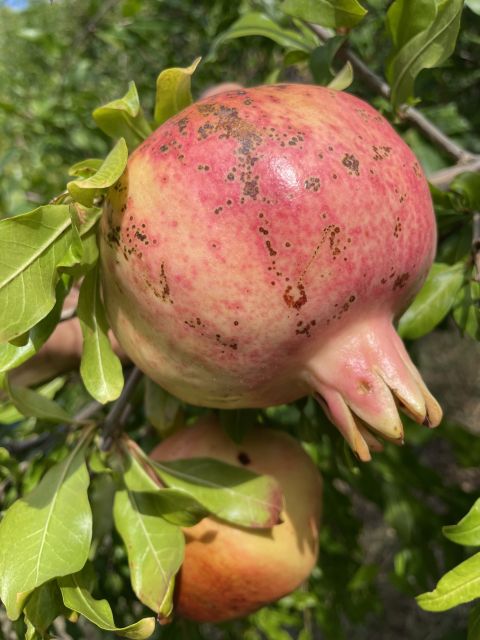
Punica granatum ´Suhr Anor´ - hardy pomegranate /MEGANEWS
Price
30 €with VAT
26,79 € without VAT
Availability:
Skladem
Weight:
2 kg
- Description
- Enquiry
- The 'Surh Anor' variety (often spelled Surh-Anor or Suhr Anor) of the pomegranate (Punica granatum) is a top-quality, highly hardy Russian/Turkmen variety.
- It originates from the renowned collection of Soviet specialist Dr. Gregory Levin at a research station in Turkmenistan (originally registered as selection R-35). In the horticultural world, it is valued as one of the most suitable varieties for marginal and colder regions.
- Characteristics of the 'Surh Anor' variety
- Fruit appearance: The fruits are large. The skin has an unusual, very attractive coloration—it ranges from yellow-pink to light red to pastel pink. It is highly resistant to sunscald.
- Flesh and seeds (aryls): The seeds inside the fruit are clear, yellowish to light pink speckled. Although the juice is not dark red, its quality is excellent.
- Taste: The taste is exceptionally sweet with very low acidity. The variety is distinguished by its high sugar content, and the fruits are excellent both for fresh consumption and for pressing sweet juice.
- Hardiness and Cultivation in the Czech Republic
'Surh Anor' is popular among growers in colder climate zones due to two key characteristics: - High frost resistance: It is one of the hardiest varieties on the market, classified in USDA Zone 7 (it can withstand short-term frosts down to around \(-15\) °C to \(-18\) °C).
- Late budbreak: This variety emerges from winter dormancy later in the spring than other marhaníks. As a result, its buds reliably escape late spring frosts, which otherwise often destroy young shoots and flowers in the Czech Republic.
- Moisture tolerance: Unlike Mediterranean varieties, its fruit does not suffer from rot or damage even if the fall is rainy and damp.
- How to grow it?
- Form: It grows as a vigorous, multi-stemmed shrub reaching a height of about 2.5–3 meters under optimal conditions. It can easily be kept smaller through pruning.
- Habitat: It requires maximum sun (ideally against a south-facing wall) and perfectly well-drained, rather dry soil. [1, 2]
- Wintering: In the warmest regions of the Czech Republic (southern Moravia, sheltered locations in Prague), it is worth trying to plant it directly in the ground with good winter protection during the first few years. In other regions, it is safer to grow it in a large pot as a portable plant that you can bring indoors for the winter to a frost-free room (0 to 8 °C).
- Are you wondering if this variety is commonly available in the Czech Republic, or do you need advice on how to prune it properly so it blooms and bears fruit abundantly?